The Spider Nest: Spider Games
- 4.6
- Rating
- 5.00M
- Installs
- Free
- Price

 Analysis by App-foxy
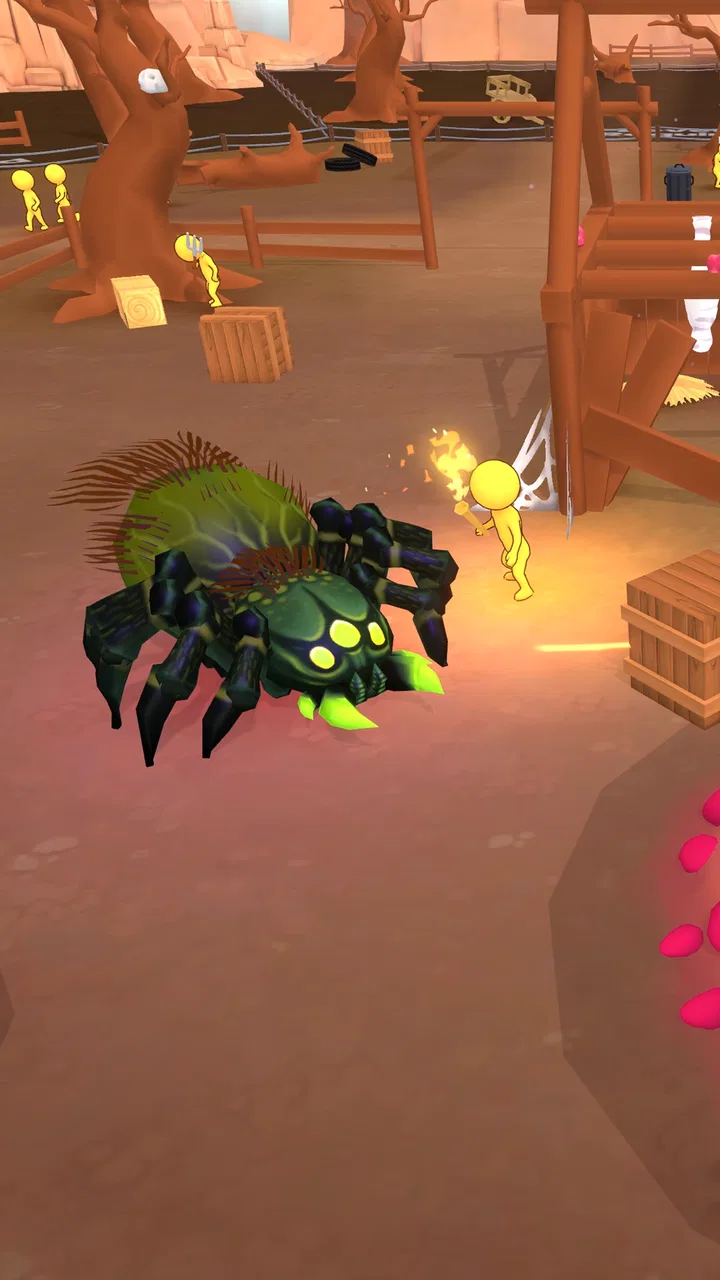
I spent time with The Spider Nest: Spider Games as a quick arcade game built around one clear fantasy: growing a spider and defending its nest from human intruders. That premise is easy to understand within seconds, and it gives the game a more focused identity than an arcade title that simply throws unrelated challenges at you. You are not managing a broad strategy empire or exploring a large role-playing world; the appeal is the immediate satisfaction of becoming a more dangerous creature and dealing with the threat inside your territory.
It comes from Homa, a developer known for compact mobile games designed to be picked up quickly. This release sits in the arcade category, is free to install, and is aimed at players aged 10 and over. The current version is 0.8.0, and it runs on Android 7.1 or later. Those details make it accessible to people using older Android devices, although the experience still depends on how well a particular phone handles the game.
The most important thing to understand before downloading is the cost structure. You can start playing without paying, while optional in-app purchases range from $0.99 to $19.99 per item. That means the initial value is easy to judge: the entry price is zero, so trying it for a few sessions carries little financial risk. The more difficult question is whether the free experience remains satisfying if you play regularly and whether optional purchases feel worthwhile to you. I would not treat the listed purchase range as a promise of better value; it simply tells you that spending can become part of the experience.
You May Also Like

 Blood Strike: 2.5 Anniversary
Blood Strike’s Loadouts Turn Every Drop Into a Tactical Gamble
A close look at Blood Strike’s custom loadouts: how fast access to signature weapons reshapes its battle royale rhythm, rewards preparation, and narrows the gap between fights.

 Pandora - Music & Podcasts
Pandora’s Music Is Easy to Start, but Harder to Recover
Pandora’s strength is its low-effort path from a seed to a station. Its weak spot is how much confidence it asks you to place in connection, setup, and quiet recovery.

 8 Ball Pool
 Is Built on Rivalries, Rematches, and Routine
A close look at the rivalries, rematches, shared routines, and unanswered safety questions that turn a quick pool match into a persistent mobile community.

 Samsung Music
’s Quiet Strength Is Playing What You Already Own
Its reach comes less from spectacle than from dependable access to a personal library. That simplicity is both the app’s strongest retention engine and its ceiling.

 AccuWeather: Weather Radar
AccuWeather Review: A Quick, Clear Forecast for Everyday Decisions
For everyday plans, the best forecast is the one you can understand quickly. AccuWeather makes rain timing, radar, and local conditions easy to act on, with a few trade-offs.

 Hill Climb Racing
Why Hill Climb Racing Still Turns Crashes Into One More Run
A tiny car, a bumpy hill and one more upgrade: Hill Climb Racing keeps resurfacing because its simple chaos makes every near-miss feel personal.
More From Our News Desk



How the spider-growth loop feels in practice
The central loop is deliberately direct. I enter the nest, deal with invading humans, and work toward a stronger spider. That combination of defense and evolution gives each short session a simple purpose. Instead of wondering what the game wants me to do, I always have a clear answer: survive the pressure, improve my creature, and push the nest further.
That clarity is one of the game’s strongest qualities. Arcade games often work best when the first few minutes explain the main idea without a long tutorial, and this title benefits from not needing a complicated explanation. The spider theme also gives ordinary progression a little more personality. Becoming stronger is not just an abstract upgrade; it fits the fantasy of a creature growing into a larger threat within its own habitat.
I found the concept especially suitable for short breaks. If I had only a few minutes while waiting for an appointment or taking a break from work, I could understand the objective immediately and get into the action without preparing a long-term plan. That makes it more convenient than slower strategy games, where a brief session can feel like an interruption rather than a complete activity.
At the same time, the narrow focus is also the main limitation. Players who need a deep story, a wide map, detailed character customization, or a large collection of modes may find the nest-and-invasion idea repetitive. The game’s identity comes from repeating and refining one fantasy, not from constantly changing its genre. If you enjoy arcade games because of their quick rhythm, this focus helps. If you need substantial variety, it may wear thin sooner.
Why the theme matters more than it first appears
The spider setting is not just decoration. It changes the emotional tone of the usual defense game. Protecting a base is familiar, but protecting a nest as a growing spider makes the objective feel more personal and slightly mischievous. The human invaders are easy to understand as a threat, while the spider’s evolution provides a natural reason to keep returning.
That gives the game a useful advantage over a generic arcade shooter or endless runner: it has a recognizable point of view. I am not simply chasing a high score with an interchangeable character. I am building up a creature that belongs in the environment. Even when the underlying actions are straightforward, that framing helps the sessions feel connected.
Still, I would not recommend it to someone looking for a serious horror experience. The age rating is Everyone 10+, which places it in a broadly accessible space rather than an intense or disturbing one. The spider premise may attract horror fans, but the game is better approached as light arcade entertainment with a creature-versus-invader setup.
Practical ways to get more from each session
My first useful tip is to treat each attempt as a small experiment rather than rushing through every encounter. The obvious temptation is to focus only on eliminating the nearest human threat, but the better habit is to notice how your current strength affects the pace of the nest. When a run starts feeling too aggressive, taking a moment to understand the situation can prevent a promising attempt from turning into a frantic one.
A second tip is to use the game as a transition activity instead of expecting it to replace a longer gaming session. It works best when I want a contained burst of action, not when I am settling in for a complex evening game. That distinction matters because the same simplicity that makes it convenient can make a long uninterrupted session feel less rewarding.
A third consideration involves spending. Since the game is free to start and offers purchases from $0.99 to $19.99 per item, I would play long enough to decide whether the basic loop itself is enjoyable before buying anything. Optional spending cannot fix a gameplay loop that does not hold your attention. If the spider-growth idea already feels repetitive without purchases, paying is unlikely to solve the underlying problem.
I would also keep an eye on the version number when judging the experience. Version 0.8.0 suggests a product that is still relatively early in its development path, so I would approach it as a game that may continue to change rather than as a completely settled arcade package. That does not make it a bad choice, but it does make patience more important for players who dislike rough edges or evolving systems.
How it compares with other arcade choices
Compared with an endless runner, this game offers a stronger sense of ownership because the nest and spider give the action a home. An endless runner is usually about maintaining momentum and beating a previous distance, while this experience is built around defending a specific space and becoming more capable. I prefer the spider game when I want a theme-driven objective rather than pure reflex repetition.
Compared with a tower-defense title, it feels more immediate and less like a planning exercise. Traditional tower defense usually rewards careful placement, timing, and long-term arrangement. Here, the creature itself is the center of the fantasy, so the experience is better for someone who wants to feel directly involved rather than managing a battlefield from above.
Compared with a larger action game, the trade-off is obvious. This title is easier to start and less demanding of my time, but it cannot offer the same depth as a game built around a large campaign, extensive equipment, or a detailed world. I would choose it for accessibility and quick entertainment, not for a substitute for a full-scale adventure.
That comparison also clarifies who should skip it. If your favorite mobile games are competitive multiplayer titles, narrative adventures, or deep management simulations, the focused spider loop may not provide enough variety. The game is a better match for someone who likes a clear objective, arcade pacing, and a playful creature theme.
What the free starting point is worth
Because there is no purchase required to begin, the strongest value proposition is the ability to test the core idea immediately. I can find out whether defending the nest and evolving the spider feels satisfying without committing money first. For casual players, that is meaningful value: the game can fill short gaps in the day while keeping the financial decision optional.
The broader audience response supports its visibility. It has a 4.6 average from around 86 thousand ratings, with over 5 million installs and roughly 1.4 thousand written reviews. Those figures show that many people have tried it and rated it positively, but they should not replace personal testing. A popular arcade loop can still be a poor fit for someone who dislikes repetition or prefers more control over progression.
I see the free access as most valuable for curious players who enjoy sampling mobile games. It is also useful for families deciding whether a game with a spider theme is appropriate for an older child, since the age guidance is Everyone 10+. I would still look at how the individual player reacts to the theme and the purchase prompts, particularly if the device is shared.
The paid side requires more restraint. The available purchase range reaches $19.99 per item, so the game can move from a no-cost trial to a more expensive habit if spending is not monitored. I would set a personal limit before buying and judge every purchase by whether it improves enjoyment over several sessions, not whether it produces a brief burst of progress. Free access is the clear starting value; paid value depends on how much the player already likes the loop.
Where the experience may lose momentum
The biggest friction is repetition. The spider-versus-human premise is memorable, but a memorable premise still needs enough variation to support extended play. I enjoyed the clarity at the beginning, yet I would be cautious about recommending it as a player’s only mobile game. It works better alongside other titles that offer different pacing or deeper decision-making.
Another trade-off is accessibility versus depth. The straightforward structure makes the game approachable, but it also limits the number of reasons to return for players who want complex mastery. Someone who likes discovering layered systems may quickly start asking for more strategic choices than this kind of compact arcade format is designed to provide.
The early version is another reason to keep expectations realistic. I would not download it expecting the polish or breadth of a long-established premium game. Its appeal is immediate play, a distinctive theme, and free entry. Players who are particularly sensitive to unfinished-feeling presentation should try it with that context in mind.
There is also a personal preference involved in the subject matter. Some people find spiders entertaining or unusual; others simply do not enjoy controlling them. The game cannot remove that reaction because the spider is the entire premise. If the theme makes you uncomfortable, the otherwise simple arcade structure may not be enough to compensate.
Who I would recommend it to
I would recommend this game to someone who wants a free arcade title with a clear identity and short-session convenience. It is a good candidate for a player who enjoys watching a creature grow stronger, likes defending a territory, and does not need a large story to justify opening a game. It also suits people who prefer trying before spending, since the basic entry point does not require payment.
A realistic everyday use case is a commuter with a few minutes between connections. Instead of opening a demanding role-playing game and worrying about losing track of a quest, that player can enter the nest, deal with the immediate threat, and put the phone away. The same applies to a student taking a short break or anyone who wants a quick distraction that has more direction than endlessly scrolling through social media.
I would be less enthusiastic for a player who wants a one-time premium purchase with no temptation to spend further. The game is free, but optional items can cost between $0.99 and $19.99, so it is not the cleanest match for someone who specifically wants a fully paid, fixed-price experience. In that case, a premium arcade game may offer a more predictable relationship between cost and content.
I would also point strategy fans toward a deeper defense game if their enjoyment comes from planning layouts, balancing multiple resources, or solving increasingly complicated scenarios. This title’s strength is the direct spider fantasy, not the promise of a detailed strategic toolbox. Choosing the alternative would not mean this game is poor; it would simply mean the player values a different kind of control.
My verdict on installing and spending
My recommendation is to install it if you are curious about a light, theme-led arcade game and want to test the idea without paying upfront. The combination of a growing spider, a nest to protect, and invading humans gives the experience a stronger hook than many interchangeable quick-play titles. I also appreciate that it can fit naturally into short breaks rather than demanding a major time commitment.
I would skip it if you need a deep campaign, extensive variety, or a guaranteed premium experience without optional purchases. The focused loop may not hold your interest for long, and the early version makes it sensible to leave room for future refinement. Players who dislike spiders should also trust that instinct, because the theme is central rather than incidental.
For spending, my advice is simple: play for free first and only consider an item after the basic sessions already feel worthwhile. The free access provides the safest way to judge the game, while the purchase range means paid value should be considered carefully rather than assumed. The best value here is the chance to try a distinctive arcade concept at no initial cost, not an automatic reason to buy upgrades.
Overall, I see it as a pleasant, focused choice for casual arcade players who want something more memorable than a generic score chase. Homa has built the appeal around a single unusual idea, and that idea works when I want immediate action with a little progression attached. It is not the right game for every mobile player, but for the right person, the nest provides a compact and entertaining place to spend a few spare minutes.
FAQs for The Spider Nest: Spider Games
01What is The Spider Nest: Spider Games about?
The Spider Nest: Spider Games is an immersive adventure game where players navigate through intricate webs, solve puzzles, and engage in strategic gameplay. You play as a spider exploring diverse environments, battling foes, and uncovering hidden secrets. The game combines elements of strategy, adventure, and puzzle-solving, offering a unique gaming experience.
02Is The Spider Nest: Spider Games free to play?
Yes, the game is free to download and play on both Android and iOS platforms. However, it offers in-app purchases for various upgrades and items that can enhance your gameplay experience. While these purchases are optional, they can provide advantages in navigating through more challenging levels.
03Does The Spider Nest: Spider Games require an internet connection?
No, The Spider Nest: Spider Games can be played offline, making it a great option for gaming on the go without the need for a constant internet connection. However, certain features like leaderboard updates and in-app purchases do require an internet connection.
04What are the minimum device requirements for The Spider Nest: Spider Games?
For Android, the game requires at least Android 5.0 and 2GB of RAM for optimal performance. For iOS, it requires iOS 11.0 or later. The game is designed to run smoothly on most modern smartphones, but older devices may experience slower performance or lag.
05How does the game handle player data and privacy?
The Spider Nest: Spider Games adheres to strict privacy policies to protect player data. It collects only essential information necessary for gameplay and account management. The game does not share personal data with third parties without consent, ensuring a safe and secure gaming environment.
Pros
- Engaging gameplay with unique spider mechanics.
- Stunning graphics and immersive environments.
- Regular updates with new levels and features.
- Intuitive controls suitable for all ages.
- Challenging puzzles that keep players hooked.
Cons
- In-app purchases can be quite pricey.
- Occasional ads disrupt the gaming experience.
- Requires a stable internet connection to play.
- Some levels may feel repetitive over time.
- Limited offline gameplay options.

The Spider Nest: Spider Games
Gallery